Home Organization & Cleaning That Works
Walk into any bookstore and you’ll find an entire shelf dedicated to home organization. Watch five minutes of a home makeover show and everything looks spotless by the last commercial break. Yet somehow, millions of people still can’t find their car keys or figure out why the kitchen counter is always a disaster by Wednesday. The advice isn’t bad. Most of it is actually quite sensible. The problem is that it tends to treat organizing as a one-time event rather than an ongoing habit — and that’s where things unravel.
Real organization doesn’t happen in a weekend blitz. It grows out of small, consistent decisions made every single day. That’s not the glamorous answer people want, but it’s the honest one. This guide takes a different approach. Instead of telling you to buy a specific type of basket or follow a rigid color-coding system, it focuses on the thinking behind lasting tidiness — and then gives you concrete, room-by-room strategies that actually stick.
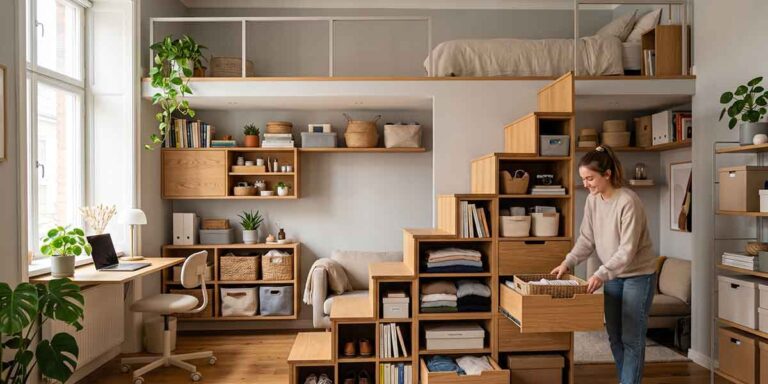
Whether you live in a 400-square-foot studio or a five-bedroom house, the core principles are the same. Clutter is a decision problem, not a space problem. Cleaning stays manageable when it’s treated as maintenance rather than crisis control. And a home that feels organized isn’t necessarily minimalist — it’s simply a home where everything has a logical place and actually ends up there.
Why Clutter Accumulates
Clutter doesn’t usually arrive all at once. It sneaks in through small, unremarkable moments — the mail dropped on the counter instead of sorted, the coat draped over the chair rather than hung up, the shopping bag left on the stairs “just for now.” Each individual decision seems harmless, but they stack up fast. Within a week or two, those small concessions transform into a visual noise that drains your energy every time you walk through the door.
Psychologists call this “decision fatigue.” The more small choices you have to make throughout the day, the harder it becomes to make good ones by evening. When you’re tired and your home doesn’t have a clear system, the path of least resistance wins every time. That’s not a character flaw — it’s just how human energy works. The fix isn’t discipline; it’s design. Set things up so the easiest choice and the right choice are the same thing.
The Three Types of Clutter
Before you start sorting and purging, it helps to recognize that not all clutter is the same. There are roughly three categories:
- Transient clutter — items that are in the middle of being used or put away. Keys on the counter, a jacket on a chair, shoes by the door. This clutter isn’t a problem; it’s just life in motion. It needs a landing spot, not a lecture.
- Homeless clutter — items that don’t have a designated spot, so they drift. A random power adapter, a gift card with an unknown balance, a single chopstick. These need to be either given a home or let go.
- Sentimental clutter — items kept out of obligation or guilt rather than genuine use or love. This is the hardest category to deal with and the one that requires the most honest conversations with yourself.
Identifying which type you’re dealing with changes how you approach it. You don’t need to make peace with a sentimental item the same way you deal with a rogue extension cord.
The One-In, One-Out Rule
This is probably the single most effective rule in all of home organization, and it’s almost embarrassingly simple: every time something new comes into your home, something old leaves. Buy a new pair of shoes? An old pair goes. Get a new kitchen gadget? An old one gets donated or tossed.
Most people treat their homes like they have infinite capacity, when in reality they have very finite shelf space, drawer space, and closet space. The one-in, one-out rule forces you to make a decision at the point of acquisition rather than during a frantic cleaning session months later. It also changes how you shop. When you know something has to leave to make room, impulse purchases start to feel less appealing.
Building an Organizing System That Lasts
Start with a Home Audit
Before buying a single storage bin or rearranging any furniture, walk through your home with fresh eyes and ask one question in each room: what are the recurring messes here, and why do they keep coming back? Write it down. Be brutally honest. If the kitchen counter is always piled with stuff, there’s a reason. Maybe the mail has nowhere logical to go. Maybe the kids drop their backpacks there because it’s the first surface they hit when they walk in. The problem is usually systemic, not personal.
This audit also tells you where to focus your energy first. Most people try to tackle everything at once and burn out within a week. Pick the spot that causes you the most daily frustration and start there. One well-organized area builds momentum and teaches you what works for your specific habits before you take on the rest of the house.
The Four-Box Method
When it comes time to actually sort through belongings, the four-box method is one of the most reliable approaches around. Set up four containers — boxes, bins, or bags — labeled: Keep, Donate, Trash, and Relocate. Work through one area at a time and put every single item into one of those four categories. No maybes. No “I’ll think about it” piles. The “relocate” box is for things that belong somewhere else in the house — it keeps you from running back and forth mid-session.
The power of this method is its specificity. Vague sorting leads to vague results. When you’re forced to make a binary call on every object, the process moves faster and you end up with a genuinely sorted space rather than a shuffled one.
Give Everything a Home
Every item in your home needs a specific, consistent place where it lives. Not a general zone — an actual spot. The scissors don’t live “in the kitchen”; they live in the second drawer to the right of the stove. The phone charger doesn’t live “somewhere in the bedroom”; it lives on the nightstand in the charging station.
This sounds obsessive, but it’s actually liberating. When things have a fixed address, putting them away becomes automatic. And more importantly, finding them becomes effortless. You stop spending those maddening ten minutes every morning searching for something you use every single day.
Store Things Near Where You Use Them
One reason systems fail is that the “right” place is inconvenient. If the batteries live in the basement but you always need them in the living room, you’ll keep leaving dead remotes on the coffee table and making a special trip that somehow never happens. Store things close to their point of use, even if that means keeping a small supply in a second location.
Think about how you actually move through your home on a typical day, and organize around those patterns rather than some idealized version of how you think things should work. Your home should fit your life, not the other way around.
Contain What You Keep
Containers — bins, baskets, trays, drawer dividers — do two important things. First, they group like things together so you’re not rummaging through a jumble to find what you need. Second, and perhaps more importantly, they create a built-in limit. When the bin is full, it’s full. You can’t keep adding things without taking something away. A good container essentially does your decision-making for you.
That said, resist the urge to buy a lot of storage products before you’ve sorted and purged. It’s one of the most common mistakes people make — spending money on bins to hold things they should have gotten rid of in the first place. Declutter first, then shop for containers based on what you actually need to store.
Room-by-Room Organization
The Kitchen
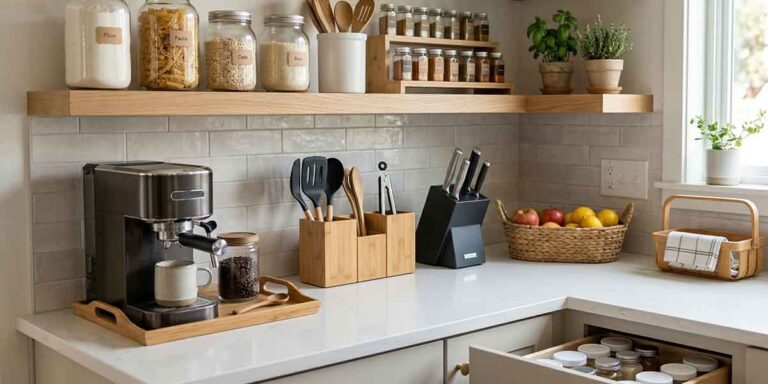
The kitchen is the most used room in most homes and also the most likely to fall into chaos without regular maintenance. The foundation of a well-organized kitchen is counter space — specifically, keeping the counters as clear as possible. Every appliance sitting on the counter should earn its place by being used at least several times a week. The bread maker you used twice in 2021? It belongs in a cabinet or out of the house entirely.
Inside cabinets, group things by how they’re used rather than what they are. Pots and pans go near the stove. Plates and glasses go near the dishwasher or sink for easy unloading. Baking supplies stay together, separate from everyday cooking tools. This seems obvious until you actually audit a typical kitchen and realize the coffee mugs are in a cabinet across the room from the coffee maker.
A few kitchen-specific tips that make a noticeable difference:
- Use drawer dividers for utensils. A jumbled utensil drawer is one of those small daily annoyances that adds up.
- Stack pots with their lids stored separately (in a rack or on the inside of a cabinet door) to save serious space.
- Go through the pantry and refrigerator every week before grocery shopping — not just to avoid buying duplicates, but to catch things before they expire.
- Designate one spot — and only one spot — for mail and incoming papers. A small tray or wall-mounted pocket near the door works well.
The Bedroom
The bedroom should feel like a retreat, but for many people it becomes a dumping ground for everything that doesn’t have a home elsewhere. The most impactful change you can make in a bedroom is to deal ruthlessly with the flat surfaces — dresser tops, nightstands, and the floor at the foot of the bed. If things routinely end up piled there, ask yourself why and whether there’s a better system you could build.
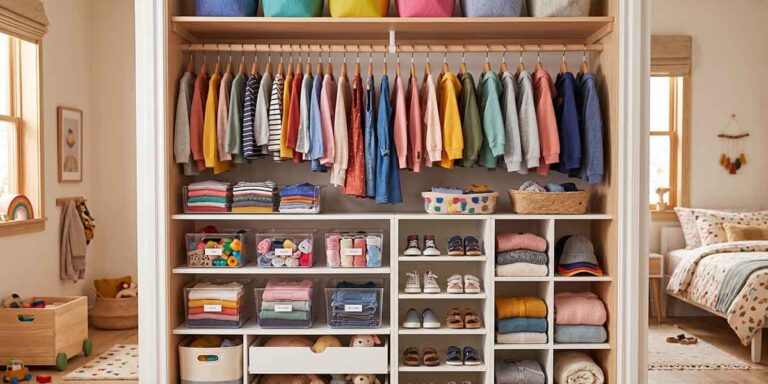
Closets deserve their own attention. Most people use only about 20% of their wardrobe regularly, yet that other 80% takes up space and makes finding the 20% harder. A good closet edit involves pulling everything out, trying on anything you’re not sure about, and being honest about whether each item still fits your body, your life, and your taste. Clothes that don’t get worn don’t “spark joy” — they generate guilt every time you see them.
After the purge, organize what’s left by category and by how often you reach for it. Everyday items go at eye level and easy reach. Seasonal or rarely worn pieces go on high shelves or in labeled bins. Hanging organizers, shoe racks, and slim velvet hangers can dramatically increase the effective capacity of even a small closet.
The Living Room
Living rooms tend to suffer from what you might call the “drop zone” effect. Everyone passes through, everyone leaves something. Remotes, chargers, books, magazines, kids’ toys, shoes that somehow migrated from the entryway. The antidote isn’t rigid rules but a few well-placed containers that make tidying fast.
A basket or bin in the corner for throws and pillows takes ten seconds to tidy. A tray on the coffee table corral the remotes and any small items that always end up there. A media console with doors hides gaming equipment, cables, and anything else you don’t want on display. The goal isn’t a magazine-perfect room — it’s a room that can go from comfortable chaos to presentable in under five minutes.
The Bathroom
Bathrooms have small footprints but handle a lot of stuff — toiletries, medications, cleaning supplies, towels, and that inexplicable collection of hotel shampoo bottles. The first step is an honest product audit. Most households are running duplicates, near-empty bottles they never quite finish, and products they bought and didn’t like. Toss them.
Under-sink cabinets are often wasted vertical space. A small set of pull-out drawers or stackable bins can double the usable storage there. Inside bathroom drawers, dividers are worth every penny — especially in a shared bathroom where everyone’s stuff tends to collide. Keep daily-use items front and center, and put everything else behind or below.
The Home Office or Work Area
For anyone working from home, the desk area is critical. A disorganized workspace doesn’t just look bad — research consistently shows it impairs concentration and raises stress levels. The most important thing you can do is keep the desk surface clear except for what you actively use. Everything else needs to be stored nearby but off the surface.
Paper management is the perennial challenge. The only long-term solution is to handle paper as it comes in: read it, act on it, file it, or toss it. A system with three file folders — Action, Pending, and Archive — handles 90% of what passes through most home offices. Everything else is either filed by topic in a small filing cabinet or scanned and stored digitally.
Cleaning That Actually Gets Done
The Mindset Shift
Most people think of cleaning as something they do when things get bad enough. The house reaches a threshold of visible dirt or company is coming over, and suddenly you’re scrubbing everything in a frantic Saturday session. That model is exhausting and demoralizing, because the gap between “bad” and “clean” always feels enormous.
The alternative is maintenance cleaning — doing small things frequently so nothing ever gets truly bad. A house that gets ten minutes of attention every day never reaches the state that requires a half-day overhaul. This isn’t about perfectionism. It’s about making the work spread out and manageable rather than concentrated and dreadful.
Daily Habits That Keep a Home Clean
Certain daily habits have an outsized impact on how clean and organized a home feels. None of them take more than a few minutes individually:
- Make the bed every morning. This single habit has a disproportionate effect on how the whole bedroom feels. A made bed signals order and makes the rest of the room look better by association.
- Wipe down the kitchen after cooking. A damp cloth on the counters and stovetop takes 90 seconds and prevents the buildup that turns a quick clean into a scrubbing session.
- Run the dishwasher at night, empty it in the morning. An empty dishwasher means dirty dishes actually get put in it rather than left in the sink.
- Do a “loop” before bed. A five-minute walk through the main living areas returning things to their homes before you sleep means you wake up to a reasonably tidy house every morning.
- Handle laundry in complete cycles. The worst laundry problem isn’t washing — it’s the clean pile that sits in the basket for four days. Commit to putting clothes away on the same day they come out of the dryer.
Weekly Cleaning: A Realistic Rotation
Weekly cleaning doesn’t have to mean cleaning the entire house every seven days. That’s an enormous task that many people simply won’t sustain. Instead, consider splitting tasks across the week so no single day is overwhelming. Here’s a structure that works for many households:
- Monday: Bathrooms — toilets, sinks, mirrors, floors. Gets the least pleasant tasks out of the way early.
- Tuesday: Dust all surfaces — shelves, furniture, electronics, ceiling fans.
- Wednesday: Vacuum all floors and rugs.
- Thursday: Mop hard floors; wipe down appliances and cabinet fronts in the kitchen.
- Friday: Change bed sheets, clear any accumulated clutter from common areas.
Each task takes 15–30 minutes when done regularly because nothing has been allowed to reach a critical state. Adapt the schedule to your life — the point isn’t the specific day but distributing the work so it never piles up.
Monthly and Seasonal Deep Cleaning
Beyond the weekly routine, certain tasks need attention only monthly or seasonally. Monthly tasks might include cleaning inside the microwave and oven, scrubbing the bathroom grout, wiping down baseboards, cleaning window sills, and washing trash cans. These are the tasks that are easy to skip but matter for a home that smells and feels truly clean rather than just superficially tidy.
Seasonal tasks — done every three months or twice a year — include washing windows inside and out, deep-cleaning the refrigerator, cleaning behind and under large appliances, washing curtains and window treatments, and rotating seasonal items in and out of storage. Spring and fall are the traditional moments for these tasks, but pick timing that works with your own schedule.
Cleaning Products: Less Is More
The cleaning product aisle is designed to make you think you need a different spray for every surface in your home. In reality, most households can handle the vast majority of their cleaning with a short list: an all-purpose spray (either bought or made with diluted dish soap and white vinegar), a glass cleaner, a toilet bowl cleaner, a scrubbing powder for tough spots, and a floor cleaner appropriate for your floor type.
Microfiber cloths are worth mentioning separately because they’re genuinely transformative. A good microfiber cloth cleans most surfaces with just water, picks up dust without spreading it around, and lasts for hundreds of washes. Buying a pack of them and ditching the paper towels saves money and reduces waste simultaneously.
Organizing with Kids and Shared Spaces
Kid-Friendly Systems
Organizing a home with children in it requires accepting that some level of mess is healthy and normal, and building systems that are simple enough for kids to actually follow. A system that requires adult-level attention to maintain will fail the moment the adults aren’t watching, which is most of the time.
The most effective kid-friendly approach is low bins and clear labels. When a six-year-old can see exactly where the Lego goes and can reach the bin without asking for help, they’re dramatically more likely to actually put the Lego there. Picture labels for kids who can’t read yet work remarkably well. Make the right choice the easy choice, and you’ll get the right choice far more often.
Toy rotation is another approach that serves double duty. Instead of having every toy accessible at once, keep a portion of them in storage and swap them out every few weeks. Kids play more engaged and more creatively with fewer options, and the “new” toys that return from storage feel exciting even though they’re not new at all. The play space stays more manageable, and you extend the life of toys significantly.
Shared Spaces and Multiple Adults
When multiple adults share a home, the biggest organizing challenge isn’t usually systems — it’s alignment. If one person’s definition of “clean enough” is wildly different from another’s, no amount of labeled bins will fix the underlying friction. The conversation about cleaning standards and responsibilities is one that has to actually happen, preferably when no one is frustrated and there isn’t a pile of dishes in the sink.
Chore charts work better for some households than others, but the underlying principle is sound: when expectations are explicit and agreed upon, there’s less room for resentment to build. Whether you use an app, a whiteboard, or a simple verbal agreement, clarity about who does what and when makes shared spaces much smoother to maintain.
Maintaining the System Long-Term
The Monthly Reset
Even well-designed systems drift over time. Life happens — you come back from a trip and throw things wherever, you go through a busy stretch and things slip, a new category of stuff enters your life and doesn’t quite fit your existing setup. The answer isn’t starting over; it’s scheduling a monthly reset.
Once a month, walk through the house with the same audit mindset you started with. Look for things that have migrated from their homes, for categories that have outgrown their containers, for clutter that’s built up in corners. A monthly reset rarely takes more than an hour and keeps small drift from becoming a full reversal of progress.
Seasons and Life Changes
The organizing system that works for a single person in their twenties won’t necessarily work for a couple with a toddler and a dog. Life changes — and your systems need to change with them. When you move, have a child, change jobs, or even just develop new hobbies, take it as an opportunity to revisit how your home is organized. The goal isn’t to set things up once and walk away; it’s to stay curious about whether your current setup is actually serving your current life.
Dealing with Setbacks
There will be weeks where the house gets out of control. Illness, travel, big projects at work, emotional rough patches — any of these can derail even the best habits. The important thing is not to treat a lapse as evidence that you’re incapable of being organized. You’re not. You just had a hard week, and the house reflects that.
The reset is always available. Pick one room — preferably the one you spend the most time in — and spend 20 minutes getting it back in order. That one good space gives you a mental foothold, and it becomes easier to tackle the next room from there. Perfection isn’t the standard. Progress is.
The Connection Between Your Home and Your Wellbeing
Research on the relationship between living spaces and mental health has grown substantially over the past couple of decades, and the findings are consistent: clutter and disorder are genuinely stressful. They create a persistent low-level cognitive load — your brain registers the disorder and keeps processing it in the background, even when you’re trying to focus on something else. People who describe their homes as “cluttered” show higher levels of cortisol (the stress hormone) compared to those who describe their homes as “restful.”
This doesn’t mean you need a showroom. It means that putting in the effort to organize your home is a genuine investment in your daily mental state, not just an aesthetic preference. A home that feels under control helps you feel under control. A space where you can find what you need, relax without visual noise, and move through your routine smoothly has a real and measurable effect on mood, productivity, and even sleep quality.
That’s worth keeping in mind on the days when you’d rather just leave the dishes. It’s not about the dishes — it’s about the kind of space you want to come home to, and the kind of mornings you want to have. Those small daily decisions add up to something much larger than the sum of their parts.
Conclusion: Start Small, Stay Consistent
If this guide has a single overarching message, it’s this: you don’t need to be a naturally organized person to have an organized home. You need systems that fit your actual life, habits that are small enough to stick, and the patience to give yourself time to build them.
Start with one drawer. One corner of one room. Something manageable that you can finish and feel good about. Then build from there. Don’t buy anything until you know what you actually need. Don’t try to copy someone else’s system wholesale — your home is yours, with your specific rhythms and habits and stuff.
Cleaning and organization are not the destination. They’re the scaffolding that lets you live more comfortably in the space you have — so that your home supports your life rather than complicating it. That’s a goal worth working toward, one small decision at a time.