Travel Hacks & Must-Have Organizers
There is a certain kind of traveler who breezes through airport security, arrives at the hotel with everything they need exactly where they left it, and somehow never spends the first night of a trip hunting for their phone charger at the bottom of a duffel bag. That traveler is not born with special powers. They just figured out, usually after a few hard lessons, how to pack and organize with intention.
Whether you take two trips a year or twenty, the right habits and the right gear can transform the whole experience. This guide covers both — practical, field-tested travel hacks that actually hold up in real life, alongside the organizers and tools worth spending money on. Nothing here is fluff.
1. The Packing Mindset: Less Really Is More
Most people overpack. It is almost a universal truth of travel. The problem is not that people bring things they need — it is that they bring things they think they might possibly need under circumstances that rarely, if ever, come up. A second formal outfit for a beach holiday. Four pairs of shoes for a four-day trip. A full-size bottle of shampoo.
The single most liberating shift in travel packing is accepting that you can wear the same pair of jeans more than once. Once you do, the whole equation changes. You free up space, cut down on weight, and stop paying baggage fees.
The One-Bag Rule
If you can manage it, traveling with a single carry-on bag changes everything. No checked luggage fees, no waiting at baggage claim, no chance of an airline losing your suitcase before a big meeting. For trips up to ten days, most people can make one bag work with smart choices.
- Choose versatile, neutral clothing that mixes and matches easily.
- Limit yourself to two pairs of shoes — one comfortable walking shoe and one slightly dressier option.
- Rely on laundry — either hotel services or a travel-size detergent packet for sink washing.
- Leave the “just in case” items at home. If something goes wrong, you can almost always buy what you need.
2. Packing Cubes: The Organizer That Changed Everything
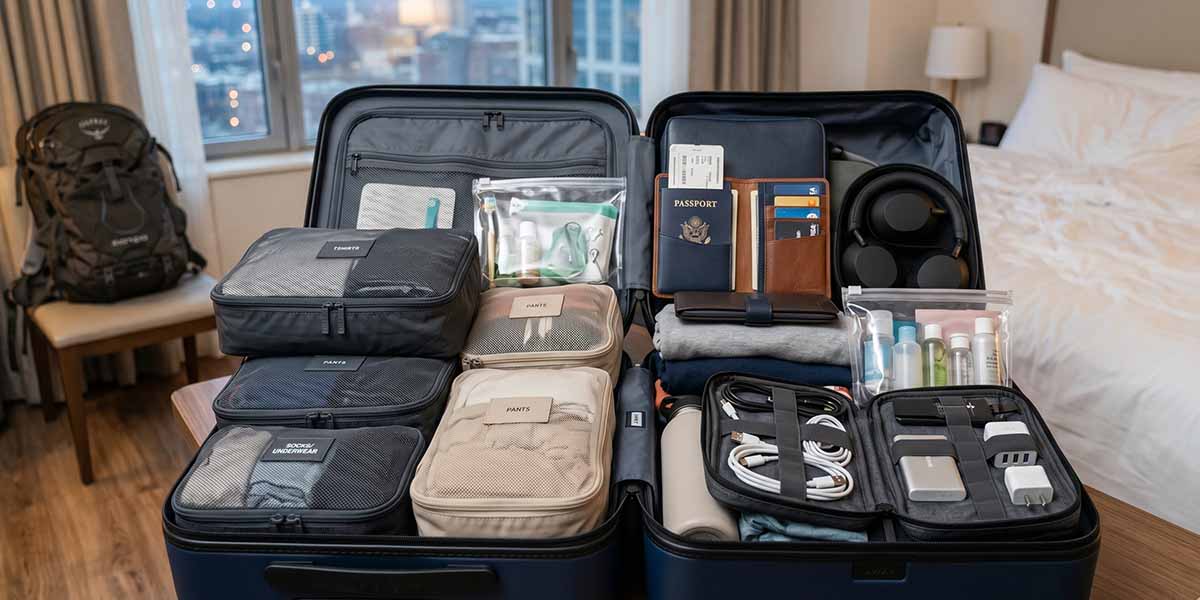
If you have not used packing cubes, they are going to feel like a revelation the first time. These lightweight zippered pouches compress and contain your clothes so your bag stops being a black hole where socks disappear and dress shirts emerge looking like they lost a fight with a dryer.
The key is to use a system consistently. Most seasoned travelers use a color-coded approach — one color for tops, another for bottoms, another for undergarments and socks. When you arrive and need something specific, you reach for the right cube instead of digging through the whole bag.
What to Look for in Packing Cubes
- Compression cubes: These have a second zipper that squeezes the cube down by about 30 percent. Worth it for longer trips.
- Mesh tops: The see-through panel means you do not have to open every cube to find what you want.
- Multiple sizes: Get a set with small, medium, and large options. Accessories and tech go in the small one, tops in medium, pants and bulkier items in large.
- Durable zippers: Cheap cubes fail fast. Look for YKK zippers if you want something that lasts years.
3. The Toiletry Bag Done Right
The toiletry situation is where a lot of people waste both space and money. Hauling full-size bottles violates carry-on liquid rules, adds weight, and leaves you with half-empty products that never get used. A purpose-built toiletry organizer with refillable bottles is a one-time investment that pays for itself in the first few trips.
The Hanging Toiletry Bag
A hanging toiletry bag is one of those things you try once and cannot imagine traveling without. Instead of spreading your products across a bathroom counter that may or may not exist, you hook the bag on a towel bar or door handle and have everything visible and accessible at once. Look for one with a solid hook rated for some weight, multiple clear pockets, and a waterproof lining inside.
TSA-Ready Liquid Strategy
For carry-on travel, the 100ml rule is non-negotiable in most countries. The smart move is to invest in a set of high-quality refillable travel bottles — leak-proof ones with flip caps or pump tops — and label them clearly. Silicone bottles are better than plastic for durability. Keep your toiletry bag pre-packed between trips so it is always ready to go.
- Pre-fill your travel bottles after every trip so you never have to do it the night before.
- Use solid toiletries where possible — shampoo bars, solid conditioners, and toothpaste tablets take up almost no space and have no liquid restrictions.
- A clear quart-size bag goes on top of your toiletry kit for security screening, not buried in the middle.
4. Tech and Cable Management
Cables have a way of multiplying in bags. You pack three and somehow unpack a tangled ball of six. A dedicated electronics organizer — essentially a zippered case with elastic loops and pockets of different sizes — keeps everything in its own slot and makes security screening much faster.
The Electronics Organizer Essentials
- A flat cable organizer that lies on top of other items in your bag.
- Elastic loops in multiple sizes for cables, adapters, and a portable battery.
- A small pocket for memory cards, SIM tools, and earbuds.
- Water-resistant exterior — things spill.
Power and Charging Hacks
A universal travel adapter with built-in USB-A and USB-C ports means you only pack one plug for any destination. A GaN (gallium nitride) charger packs more wattage into a smaller body than traditional chargers, and a compact 10,000 mAh power bank handles a full phone charge or two with room to spare.
One underrated hack: pack a short multi-port USB hub. Airports and hotel rooms rarely have enough outlets, and a single hub turns one socket into several charging spots at once.
5. Document and Money Organization
Losing your passport or boarding pass in a foreign country is the kind of experience that sticks with you for years. A little organization on the document front costs nothing and prevents enormous stress.
The Travel Wallet
A dedicated travel wallet or passport holder keeps your key documents — passport, boarding passes, travel insurance card, emergency contacts, local currency — in one slim package. Look for one with RFID-blocking material, which prevents electronic pickpocketing of your credit cards and passport chip.
The Digital Backup
Before every trip, photograph the photo page of your passport and email it to yourself. Screenshot your hotel confirmation, flight details, and any activity bookings and store them offline in your phone. If your bag gets stolen, you still have everything you need to function.
- Keep a small amount of local currency separate from your main wallet — just enough for a taxi or a meal if your cards fail.
- A money belt worn under your clothes is worth it in high-theft areas, even if it feels slightly paranoid.
- Tell your bank where you are going before you leave — frozen cards abroad are more common than people expect.
6. Airport Hacks That Save Real Time
Airports are designed to move large numbers of people through a series of bottlenecks. The travelers who get through fastest are not the ones who run — they are the ones who prepared before they got there.
Check In Before You Arrive
Online check-in opens 24 hours before most flights. Doing it immediately gives you the best available seat selection before others grab them. Download the airline app and add your boarding pass to your phone wallet — it is faster to pull up than a PDF, and it updates automatically if your gate changes.
Security Line Strategy
- Wear slip-on shoes when flying. The time you save across dozens of trips adds up.
- Keep your electronics organizer on top so you can pull it out for the tray in seconds.
- Pre-check programs like TSA PreCheck or Global Entry pay for themselves after just a few trips if you fly domestically in the US.
- Look at all the security lines and join the one with the fewest large groups and families — business travelers move faster.
At the Gate and On the Plane
Board as late as possible when traveling carry-on only — the overhead bins above your seat are usually claimed by early boarders, but bins further back are often empty. Stow your bag in the first available bin and walk forward to your seat rather than hunting for space near it.
7. The Personal Item: Your Secret Weapon
Most airlines allow both a carry-on bag and a personal item — a smaller bag that fits under the seat in front of you. Many travelers treat the personal item as an afterthought, tossing in a purse or a random tote. Travelers who think about it treat it as a serious opportunity.
A well-packed personal item bag holds everything you need during the flight — headphones, snacks, your book or tablet, a neck pillow, a thin layer, your medications, and your travel documents. Your main carry-on goes overhead and you do not need to touch it until you land.
Best Personal Item Bags
- A slim backpack with a laptop sleeve and quick-access front pockets is the most versatile option.
- A structured tote works well for shorter trips and is easier to stow and retrieve.
- Check each airline’s size limits — they vary, and some low-cost carriers are strict.
8. Staying Comfortable on Long Hauls
Long-haul flights and overnight buses are uncomfortable by design. You cannot change the seats, but you can manage your own micro-environment well enough to arrive feeling like a person rather than a piece of luggage.
The Comfort Kit
- A quality neck pillow — memory foam ones hold their shape better than inflatable versions.
- Noise-canceling headphones or a good set of earplugs for flights with crying children or engine roar.
- A sleep mask — airplane window shades are never all the way down.
- Compression socks for flights over five hours — they prevent swelling and reduce the risk of DVT on long journeys.
- A light scarf or travel blanket — aircraft cabins run cold, and the blankets handed out are thin.
Jet Lag Management
The most effective method for handling jet lag is to shift your sleep schedule a day or two before departure in the direction of your destination. On the flight, set your watch to destination time immediately and eat and sleep according to that schedule rather than your home time zone. Stay hydrated and skip the alcohol — a dry cabin plus alcohol accelerates dehydration significantly.
9. Hotel Room Hacks
Arriving at a hotel and immediately feeling settled takes a bit of system. Experienced travelers develop a routine for checking in that covers the basics fast — confirming checkout time, locating the nearest exit, figuring out the Wi-Fi, and setting up their toiletry bag. It sounds trivial, but a room that feels organized within fifteen minutes of arrival makes a real difference on a five-night stay.
- Request a high floor when booking — it is quieter and the view is better. Street-facing rooms catch more noise.
- Use the hotel safe for your passport and backup cards. Keep only what you need for the day in your wallet.
- A cheap door stopper adds a layer of security in any accommodation, from a budget hostel to a business hotel.
- Packing cubes mean your suitcase can stay on the luggage rack organized — no need to unpack into drawers for a two-night stay.
10. The Master Packing List
Every experienced traveler eventually develops a master packing list — a document they return to before every trip and edit over time. If you do not have one, start building it now. It takes about three trips to get it right, and then it eliminates the mental load of deciding what to bring almost entirely.
Core Categories
- Documents: Passport, boarding passes, travel insurance, emergency contacts, printed hotel address.
- Tech: Phone, charger, power bank, universal adapter, laptop (if needed), headphones, cables.
- Clothing: The planned outfits plus one extra set, undergarments, socks, pajamas, swimwear if needed.
- Toiletries: Pre-packed toiletry bag, medications, first aid basics, sunscreen.
- Comfort: Neck pillow, sleep mask, earplugs, snacks for transit.
- Organizers: Packing cubes, electronics organizer, hanging toiletry bag, travel wallet.
11. Organizers Worth Spending Money On
Not every travel product earns its price. But a few categories of gear are genuinely worth investing in, because they last years and make every single trip better.
Packing Cubes (Full Set)
A good set of packing cubes — four to six pieces in varying sizes — will outlast multiple suitcases. Brands like Eagle Creek and Peak Design make sets that hold up to years of heavy use. Look for mesh-top designs with two-way zippers.
A Quality Travel Backpack
If you are a one-bag traveler, your bag is doing serious work. A backpack with a clamshell opening (opens flat like a suitcase), a built-in laptop sleeve, and a carry-on compliant size changes how the whole system functions. Osprey, Tortuga, and similar brands design specifically for this kind of travel.
An RFID-Blocking Travel Wallet
This is a small purchase that handles document organization, card security, and currency management in one place. Get one that holds your passport flat, has a few card slots, a clear ID window, and a zip pocket for folded cash.
Noise-Canceling Headphones
This is the one luxury that almost every frequent traveler agrees is worth every cent. The difference between a seven-hour flight with active noise cancellation and without it is hard to overstate. True wireless earbuds with ANC work well for most people; over-ear headphones provide deeper cancellation for those who do long-haul flights regularly.
Final Thoughts
Travel is one of the few things in life where the preparation genuinely shapes the experience. A few well-chosen organizers and a handful of consistent habits are the difference between a trip that starts in chaos and one that starts with your feet on the ground and your head already in the right place.
None of this requires spending a fortune or overhauling how you pack overnight. Start with one change — a set of packing cubes, a hanging toiletry bag, a dedicated travel wallet. See how much mental space it frees up. Then add from there. Within a few trips, the whole process becomes second nature.
The best travelers are not the ones who have been everywhere. They are the ones who show up ready, move lightly, and spend their energy on the place they have arrived rather than the mess in their bag.