Home Workout Plan for Beginners
Starting a fitness journey can feel intimidating, especially when you picture crowded gyms, unfamiliar machines, and people who look like they were born lifting weights. The good news is that you do not need any of that. Some of the best workouts happen right at home, with zero equipment, in whatever time you have available.
This guide is written for people who are just getting started — whether you have never worked out a day in your life, are returning after a long break, or simply want a no-fuss routine that fits into a busy schedule. You will find practical exercises, simple workout plans, and honest advice that respects your time and your limits.
By the end, you will have everything you need to build a consistent habit — one that actually sticks.
Why Working Out at Home Works
People often underestimate home workouts. There is a common belief that real results only come from gym memberships, personal trainers, and expensive equipment. That belief is simply not true. Research consistently shows that bodyweight training done regularly delivers significant improvements in strength, endurance, and overall health.
Here is what makes home workouts a genuinely smart choice for beginners:
- No commute. You save the 20 to 40 minutes most people spend driving to and from a gym. That time adds up.
- No intimidation. Learning proper form is much easier when you are not surrounded by strangers.
- No cost. The floor beneath your feet is the only equipment this guide requires.
- Total flexibility. Work out at 6 a.m. before the kids wake up, or at 10 p.m. after dinner. No one cares.
For beginners especially, home workouts remove the friction that often prevents people from starting in the first place. And removing that friction is the single most important factor in building a long-term fitness habit.
Before You Begin: Setting Yourself Up for Success
A few minutes of preparation before your very first workout will save you a lot of frustration down the road.
Clear a Space
You do not need a home gym or even a dedicated room. A clear patch of floor roughly six feet by six feet is enough for almost every exercise in this guide. Move the coffee table, roll up the rug, or head to the backyard. The space does not need to be fancy — it just needs to be consistent. Working out in the same spot every day helps your brain recognize it as a fitness space, which subtly reinforces the habit.
Get the Right Shoes
Working out barefoot on carpet is fine for many exercises, but if you are doing any jumping or fast-paced movement, wear supportive shoes. Cross-training shoes work best for general fitness routines because they provide lateral support that running shoes do not.
Consider a Yoga Mat
A basic yoga mat costs around ten to twenty dollars and makes floor exercises significantly more comfortable. It also defines your workout area visually, which is a surprisingly effective mental cue. That said, a folded blanket or thick towel works just as well if you are not ready to invest yet.
Check In with Your Doctor If Needed
If you have any existing health conditions — high blood pressure, joint problems, recent surgery, or chronic pain — a quick conversation with your doctor before starting is worth it. Most people can begin a beginner workout program without any issues, but there is no harm in double-checking.
Understanding the Basics of Exercise
Before diving into specific exercises, it helps to understand a few fundamental concepts. You do not need a degree in exercise science — just a working knowledge of how workouts are structured.
Reps and Sets
A rep (short for repetition) is one complete movement of an exercise. A set is a group of reps done without stopping. If you do 10 push-ups, rest, and then do 10 more, that is 2 sets of 10 reps. Most beginner programs use 2 to 3 sets of 8 to 15 reps per exercise.
Rest Periods
Rest between sets is not laziness — it is a necessary part of the workout. Your muscles need time to recover between efforts. For most beginner strength exercises, 60 to 90 seconds of rest between sets is appropriate. For cardio-focused exercises, shorter rest periods of 20 to 30 seconds keep your heart rate elevated.
Progressive Overload
This is the most important principle in fitness. Your body adapts to the demands you place on it. To keep improving, you need to gradually make your workouts a little harder over time. Without weights, you can do this by adding more reps, doing more sets, shortening your rest periods, slowing down your movements, or progressing to harder exercise variations.
Warm-Up and Cool-Down
Every workout should begin with five minutes of light movement to warm your muscles and joints. Marching in place, arm circles, hip rotations, and gentle leg swings all work well. At the end of your session, spend five minutes stretching the major muscle groups you worked. This reduces soreness the next day and improves flexibility over time.
The Core Exercises Every Beginner Should Know
These seven exercises form the foundation of most beginner home workout programs. Master these before adding anything else.
1. Squats
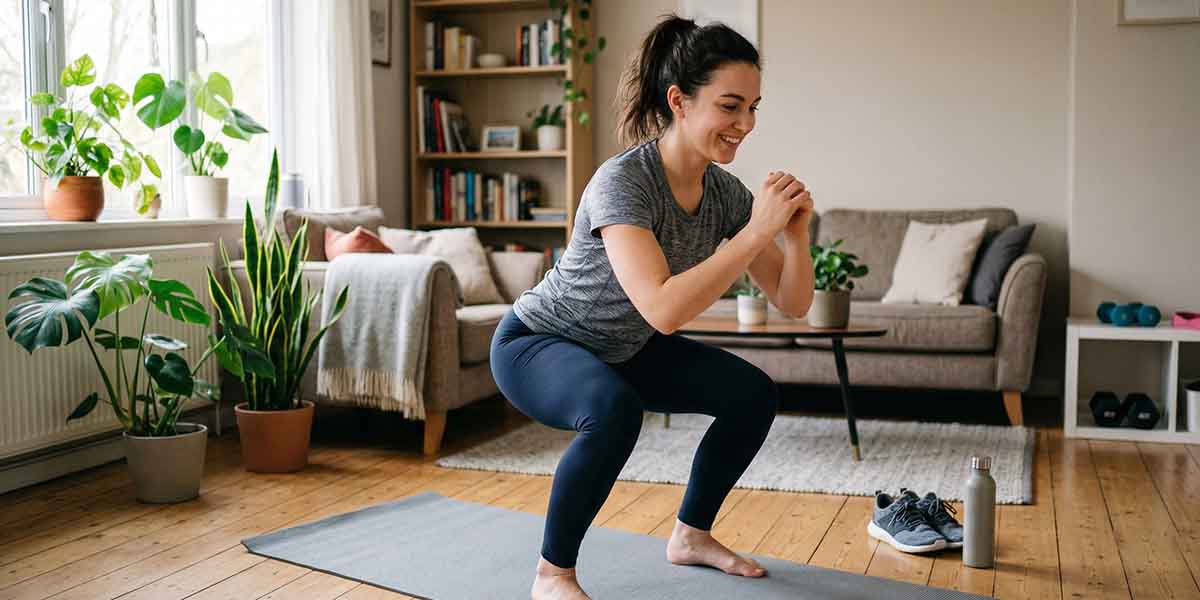
Squats train the entire lower body — quadriceps, hamstrings, glutes, and calves — all at once. They also build core stability and improve mobility in the hips and knees, which benefits everyday movement like sitting down, climbing stairs, and picking things up from the floor.
How to do it:
- Stand with your feet shoulder-width apart, toes pointed slightly outward.
- Keep your chest up and your core gently braced.
- Push your hips back and bend your knees, lowering yourself as if sitting into a chair.
- Go as low as you comfortably can — ideally until your thighs are parallel to the floor.
- Press through your heels to return to standing.
Start with: 3 sets of 10 reps. Rest 60–90 seconds between sets.
2. Push-Ups
Push-ups are one of the best upper body exercises in existence. They work your chest, shoulders, triceps, and core simultaneously. If a standard push-up is too challenging at first, start with your knees on the ground — this is not a shortcut, it is a legitimate progression step that builds the same movement pattern.
How to do it:
- Place your hands on the floor slightly wider than shoulder-width apart.
- Extend your legs behind you so your body forms a straight line from head to heels.
- Lower your chest toward the floor by bending your elbows, keeping them at roughly a 45-degree angle from your body.
- Push back up to the starting position.
Start with: 3 sets of 8–10 reps. Use knee push-ups if needed.
3. Plank
The plank is a static hold that builds core strength and stability. It teaches your body to maintain tension through the midsection, which improves posture, reduces lower back pain, and supports nearly every other exercise you will ever do.
How to do it:
- Get into the top of a push-up position, or rest on your forearms instead of your hands.
- Keep your body in a straight line — do not let your hips sag or rise up.
- Squeeze your glutes and brace your core as if bracing for a punch.
- Hold for time. Breathe normally throughout.
Start with: 3 holds of 20–30 seconds. Build toward 60 seconds over time.
4. Glute Bridges
Glute bridges target the backside — your glutes and hamstrings — which are often underdeveloped from too much sitting. Strong glutes protect the lower back, improve posture, and make squats and lunges much more effective.
How to do it:
- Lie on your back with your knees bent and feet flat on the floor, hip-width apart.
- Press your feet into the floor and lift your hips up until your body forms a straight line from shoulders to knees.
- Squeeze your glutes at the top and hold for one second.
- Lower slowly back to the floor and repeat.
Start with: 3 sets of 12 reps.
5. Lunges
Lunges train each leg independently, which helps correct muscle imbalances that develop when one side is stronger than the other. They also challenge balance and hip mobility in ways that squats do not.
How to do it:
- Stand with your feet together.
- Step forward with one foot and lower your back knee toward the floor.
- Keep your front knee above your ankle and your torso upright.
- Push through your front heel to return to standing.
- Alternate legs for each rep.
Start with: 3 sets of 8 reps per leg.
6. Mountain Climbers
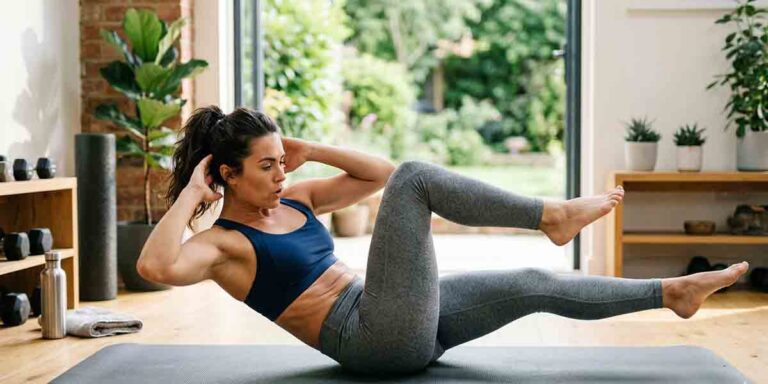
Mountain climbers combine cardio and core work in one movement. They raise your heart rate, build endurance, and strengthen the abs and hip flexors — all without leaving the floor.
How to do it:
- Start in a push-up position with your arms straight.
- Drive one knee toward your chest, then quickly switch legs.
- Keep your hips level and your core tight throughout.
- Move at a pace that challenges your breathing but allows good form.
Start with: 3 sets of 20 seconds. Build to 30–45 seconds.
7. Superman Hold
The superman targets the lower back and the muscles along the spine — an area most beginners completely neglect. Strengthening this area dramatically reduces the risk of lower back injury and improves posture.
How to do it:
- Lie face down on the floor with your arms extended in front of you.
- Simultaneously lift your arms, chest, and legs off the floor.
- Hold for two to three seconds at the top.
- Lower back down with control and repeat.
Start with: 3 sets of 10 reps.
Your First Four-Week Workout Plan
Here is a structured four-week plan built around the exercises above. It follows a three-days-per-week format, which is ideal for beginners because it gives your body enough time to recover between sessions.
Week 1–2: Building the Foundation
Workout Days: Monday, Wednesday, Friday (or any three non-consecutive days)
- 5-minute warm-up (light marching, arm circles, hip rotations)
- Squats — 2 sets of 10
- Knee Push-Ups — 2 sets of 8
- Glute Bridges — 2 sets of 12
- Plank — 2 holds of 20 seconds
- Superman — 2 sets of 10
- 5-minute cool-down stretching
Total time: approximately 25–30 minutes.
Week 3–4: Adding Volume
Same days, same structure — but with more work:
- Squats — 3 sets of 12
- Push-Ups (standard or knee) — 3 sets of 10
- Glute Bridges — 3 sets of 15
- Lunges — 2 sets of 8 per leg
- Plank — 3 holds of 30 seconds
- Mountain Climbers — 2 sets of 20 seconds
- Superman — 3 sets of 10
Total time: approximately 35–40 minutes.
Common Mistakes Beginners Make
Knowing what to avoid is just as valuable as knowing what to do.
Doing Too Much Too Soon
This is the number one reason beginners quit. Enthusiasm is great, but going from zero activity to daily intense workouts leads to extreme soreness, joint pain, and burnout within two weeks. Start with less than you think you need, then build gradually. The goal in the first month is not transformation — it is consistency.
Skipping the Warm-Up
Cold muscles do not move well. Skipping the warm-up increases the risk of muscle strains and joint discomfort. Five minutes is all it takes, and it genuinely makes the workout feel better from start to finish.
Sacrificing Form for Reps
Ten perfect squats are worth more than twenty sloppy ones. Poor form reduces the effectiveness of an exercise and increases injury risk. If your form breaks down before completing your target reps, stop there. Quality always beats quantity.
Not Resting Enough Between Workouts
Fitness does not happen during the workout — it happens during recovery. When you exercise, you create tiny tears in your muscle fibers. Rest is when those tears repair and come back stronger. Beginners should avoid working the same muscle groups on consecutive days.
Ignoring Nutrition and Sleep
Exercise is only part of the equation. What you eat and how much you sleep directly affect your results. You do not need a rigid diet plan as a beginner, but eating enough protein (found in eggs, meat, legumes, and dairy) and getting seven to nine hours of sleep each night will make a noticeable difference in how quickly you progress and how good you feel.
Staying Motivated When It Gets Hard
Motivation is unreliable. Some days you will feel energized and ready to go. Other days, the couch wins. This is normal for everyone, not just beginners. The trick is building systems that make showing up easy, even when you do not feel like it.
Schedule It Like an Appointment
Put your workouts in your calendar. Treat them with the same seriousness as a work meeting or a doctor’s appointment. The vague intention of working out ‘sometime this week’ almost never happens. A specific time does.
Track Your Progress
Keep a simple log — even just a notebook by your workout space — where you write down what you did each session. Seeing your plank hold go from 20 seconds to 45 seconds, or your push-up count increase from 5 to 15, is genuinely motivating. Progress is often invisible until you write it down and look back.
Give Yourself Permission to Do Less
On days when energy is low, cut the workout in half. A ten-minute version of your workout is infinitely better than skipping entirely. More often than not, starting the workout leads to finishing it. But even if you stop early, you showed up — and that matters.
Focus on How You Feel, Not Just How You Look
Physical changes in appearance take weeks to become visible. But you will notice you have more energy, sleep better, and feel less stiff within the first two weeks of consistent exercise. Pay attention to those changes. They are real, and they will keep you going far longer than the mirror will.
What Comes After Four Weeks
If you have followed the four-week plan consistently, your body has adapted. Exercises that felt difficult in week one feel manageable in week four. That is progress — and it means it is time to push a little further.
Here are some directions you can take:
- Add a fourth workout day per week.
- Progress to harder exercise variations — standard push-ups, jump squats, single-leg glute bridges.
- Add resistance bands, which are inexpensive and dramatically expand your exercise options.
- Explore structured programs online — there are excellent free resources for intermediate bodyweight training.
- Consider a pair of adjustable dumbbells if you want to start weight training from home.
The important thing is to keep moving forward. Fitness is not a destination — it is an ongoing practice. Four weeks from now, you will not be the same person who started. And four months from now, the difference will be even greater.
Final Thoughts
Getting fit does not require a gym, a trainer, or expensive gear. It requires showing up consistently, paying attention to your body, and being patient with the process. The exercises in this guide are simple by design — but simple does not mean ineffective.
Thousands of people have built genuinely strong, healthy bodies using nothing more than their own bodyweight and a clear patch of floor. You can too.
Start with the first week of the plan. Do not overthink it. Just start.
Everything else follows from that one decision.