Kids Closet Organization Ideas
Walk into any kid’s bedroom and the closet is usually the first thing that tells the real story. Clothes piled on the floor, shoes spilling out into the room, hangers twisted into impossible shapes, and somewhere buried at the back, a school project that was due three weeks ago. Sound familiar? You’re not alone. Kids’ closets are notoriously hard to keep organized — not just because children accumulate stuff quickly, but because most closets were never designed with a child’s habits or height in mind.
The good news is that with the right setup, a kids’ closet can go from disaster zone to a genuinely functional space — one that your child can navigate on their own and (with a little encouragement) keep reasonably tidy. This guide walks through everything from planning and sorting to storage solutions and long-term habits, so you can build a system that actually holds up past the first week.
Why Kids’ Closets Are Different
Before diving into bins and labels, it helps to understand what makes a kids’ closet unique. The obvious answer is size — children are smaller, and standard closet rods are typically hung at a height that makes no sense for a seven-year-old who needs to grab their own jacket before school.
But the bigger issue is usage patterns. Kids interact with their closets differently than adults. They’re getting dressed in a hurry, often without much thought for putting things back neatly. They grow fast, meaning their wardrobe turns over every six to twelve months. They also tend to have very mixed storage needs — clothing, yes, but also sports gear, backpacks, stuffed animals, art supplies, and whatever current obsession is taking up space this month.
A well-organized kids’ closet accounts for all of this. It’s built around accessibility, simplicity, and flexibility — three principles that will come up again and again throughout this guide.
Step One: Start with a Full Cleanout
There is no point in organizing things that shouldn’t be there. Before you buy a single bin or shelf, pull everything out of the closet. Everything. Yes, including whatever has been sitting on the top shelf since last year.
Sort items into four piles:
- Keep: Things that fit, are in good condition, and get worn or used regularly.
- Donate or hand down: Items that are outgrown, barely worn, or no longer needed.
- Relocate: Things that belong in another room — sports equipment stored in the wrong place, books that should be on a shelf, toys that belong in a playroom.
- Toss: Worn-out socks, broken gear, anything that’s beyond saving.
Involving your child in this process is worth the extra time it takes. Kids who participate in sorting are more invested in keeping things organized afterward. Let them make decisions about what to keep and what to give away — it builds a sense of ownership over the space.
A practical rule of thumb: if an item hasn’t been touched in six months and it’s not seasonal, it probably doesn’t need prime closet real estate. Rotate seasonal clothing to under-bed storage or high shelves and free up the main closet space for what’s actually in rotation.
Assessing the Closet Itself
Once the closet is empty, take a good look at what you’re working with. Measure the height, width, and depth. Note where any fixed shelving or rods are positioned. Think about what your child actually needs to store and how they’ll be accessing it.
Most standard closets have a single rod at adult height and maybe one shelf above it. This setup is almost useless for children under ten. You’ll likely need to either lower the existing rod, add a second rod at child height, or install a modular system that works better for shorter arms and developing fine motor skills.
A general guide for rod heights by age: for toddlers and preschoolers (ages 2-5), a single low rod around 36 to 40 inches off the floor works well. For early school age children (ages 6-9), a double rod setup with the lower rod at 40 to 48 inches and an upper rod for out-of-season items works nicely. For tweens and teens, the setup can gradually approach adult standard heights as they grow.
Building the Right Storage System
There’s no single perfect closet system for every child, but there are some core elements that work well across most setups.
Hanging Space
Kids don’t actually need as much hanging space as adults. Most children’s clothing — T-shirts, shorts, underwear, pajamas — does fine folded in drawers or bins. Reserve the hanging rod for items that genuinely need it: school uniforms, dress clothes, jackets, pants, and anything that wrinkles easily. This means you can often divide a standard closet rod into two shorter rods and use the rest of the vertical space for shelving.
Shelving and Cubbies
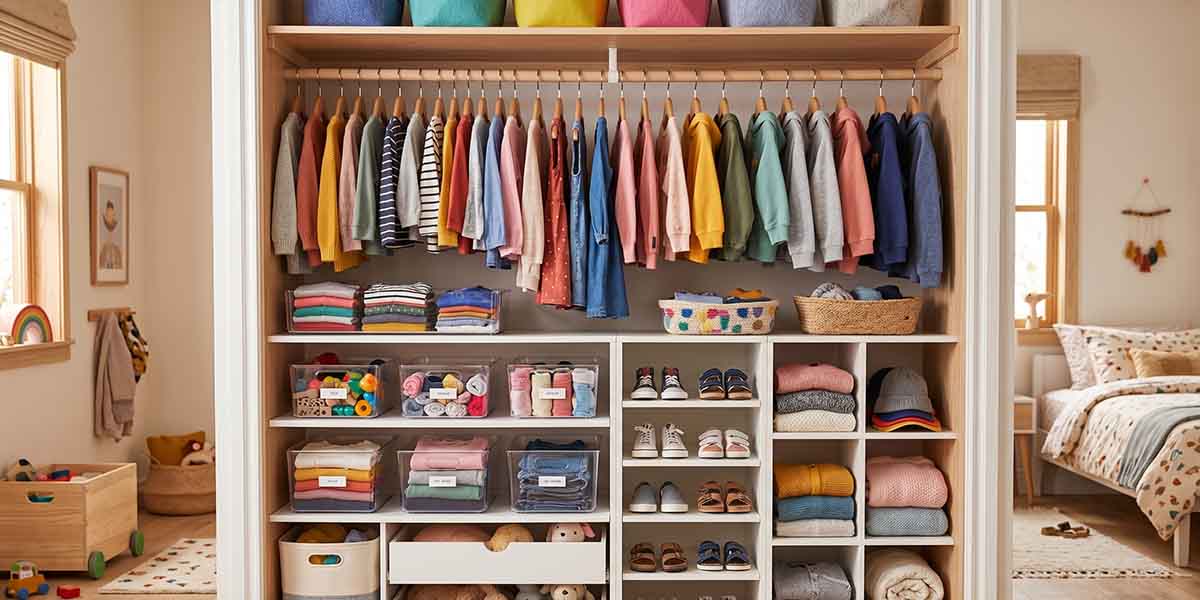
Open shelving is your best friend in a kid’s closet. When children can see what they have, they’re far more likely to use it and put it back. Deep shelves tend to become black holes where things get pushed to the back and forgotten. If you’re working with deep shelves, use bins or baskets to pull items forward and keep things accessible.
Cubbies — small, defined squares of space — are particularly effective for younger children. Each cubby has one purpose: this one is for shoes, this one is for the backpack, this one is for the soccer ball. The visual clarity removes the guesswork that trips most kids up when it comes to putting things away.
Bins, Baskets, and Drawers
For folded items, bins and fabric baskets work very well on shelves. They’re forgiving — kids can toss folded shirts in without perfect precision and things still look reasonably tidy from the outside. Choose bins with open tops rather than lids for everyday items; lids add a step that most children simply won’t bother with.
Drawer dividers are helpful if your closet includes a built-in dresser or you’ve added a small unit inside. Without dividers, small items like socks and underwear turn into one undifferentiated mass within about three days. A few simple dividers keep each category in its lane.
Shoe Storage
Shoes are consistently one of the messiest parts of any kids’ closet. The most workable solutions tend to be low — either a floor-level cubby system, a low-profile shoe rack, or a row of cubbies at the base of the closet. Over-door shoe organizers can work for smaller children’s shoes, but they tend to get ignored if the child has to look up to use them.
A realistic goal for shoe organization isn’t perfection — it’s containment. If all the shoes end up in the shoe zone, even if they’re a little jumbled, that’s a win. Aim for a system the child can use independently rather than one that requires adult-level precision to maintain.
The Power of Labels
Labels do two things: they tell children where things go, and they remove the decision fatigue of figuring out where something belongs. For younger children who can’t read yet, picture labels are a game-changer. Print or draw simple images — a shirt for the shirt bin, a shoe for the shoe area, a pair of socks for the sock drawer. The visual cue takes the mystery out of putting things away.
For older children, word labels work fine. Keep them simple and clear: “Pajamas,” “School Shirts,” “Weekend Clothes,” “Underwear.” Overly complicated category names cause the same confusion as no labels at all.
Don’t overlook the value of labeling less obvious spots too — the hook that’s specifically for the school backpack, the basket that’s always for the library books, the shelf where the cleats live. When every item has a clear home, there’s no reason for things to end up on the floor.
Organizing by Category vs. by Outfit
There are two main philosophies for how to arrange a child’s wardrobe, and the better one depends on your child’s personality and your family’s morning routine.
Organizing by category
This is the traditional approach: all shirts together, all pants together, all socks in one drawer. It’s clean, it’s easy to do laundry with, and it gives children a clear mental map of where everything lives. It works well for older children who can make their own outfit choices without much friction.
Organizing by outfit
This approach groups complete outfits together — shirt, pants, and sometimes even socks and underwear in a single bin or hanging set. It’s fantastic for young children and for families with chaotic mornings. When the child (or parent) grabs one bin, the outfit is solved. There’s no digging for matching items and no standoffs about what goes together. Some parents set up a week’s worth of outfits on Sunday evening, putting five sets in five labeled bins or hanging five complete outfit hangers. The result is a genuinely smooth Monday through Friday.
Special Considerations by Age
Toddlers and Preschoolers (Ages 2–5)
At this age, the goal is complete independence — if you want it — or easy parental access. Everything should be low and visible. A single low rod, a few open cubbies, picture labels on everything. Limit the number of choices to avoid overwhelming a small child. Having ten pairs of pants accessible isn’t necessary; three or four is plenty. Keep the rest in rotation elsewhere.
Early School Age (Ages 6–9)
This is the prime age for building good habits. Children this age can understand systems and follow them when they’re simple enough. Introduce labeled bins, a designated backpack hook, and a spot for school shoes that never moves. Involve them in decisions about how things are organized — they’ll remember the system better if they helped design it.
This is also when accessories start appearing — hair clips, hats, belts, sports gear. Build in specific spots for these things before they take over. A small basket or drawer designated for accessories prevents them from migrating everywhere.
Tweens and Teens (Ages 10+)
Older children have more complex storage needs and stronger opinions about how they want things set up. The key shift here is to hand over more control. Explain the principles — everything has a home, like things go together, clear beats hidden — and then let them make their own organizational decisions. A tween who chose their own storage bins and decided where things go is far more likely to maintain the system than one who was handed a finished setup and told to keep it tidy.
This age group also tends to have more categories: school clothes, weekend clothes, athletic wear, formal wear for occasions. Consider adding a section divider or labeled zones within the hanging area so different types of clothing each have their spot.
Shared Closets: When Two Kids Share One Space
Shared closets require clear boundaries. The number-one mistake in shared closets is treating the space as communal without defining clear zones for each child. This leads to constant disputes about whose stuff is where and clothes getting mixed up in the wash.
Divide the closet clearly — left side belongs to one child, right side to the other. Use different colored bins or baskets for each child to make the distinction visual and instant. Label sections with each child’s name if needed. Even if the closet is small and the split isn’t perfectly equal, having a defined territory for each child prevents the constant encroachment that turns shared spaces into conflicts.
For shared items — extra blankets, sports equipment used by both children, seasonal storage — designate a shared zone that both children understand is common space. This makes it clear that items there belong to neither one specifically.
Maximizing a Small Closet
Not every kid is lucky enough to have a walk-in. Many children’s rooms come with small reach-in closets that feel impossibly tight. But small doesn’t have to mean disorganized.
Vertical space is almost always underused. If there’s no shelf above the rod, add one — it’s a significant amount of storage. Over-door organizers with pockets add space without taking any up inside the closet. Slim, non-slip velvet hangers take up far less horizontal space than traditional plastic ones, which can easily double the number of items that fit on the rod.
Hooks inside the closet door are tremendously useful — one for the school bag, one for the next day’s outfit, one for the gym kit. Using the back of the door effectively can handle several categories that would otherwise compete for shelf space.
For very small closets, consider whether all clothing needs to live in the closet. A separate small dresser in the room can handle folded items while the closet is reserved for hanging clothes, shoes, and gear. This kind of split-storage approach works well when closet space is genuinely limited.
Seasonal Rotation: The Key to Closet Space
One of the most effective things you can do to maintain a manageable kids’ closet is to rotate clothing seasonally. There is no reason for winter coats to take up space in the closet during July, or for swimwear to occupy a shelf in January.
Twice a year — once in spring and once in fall — swap out the seasonal wardrobe. Pack off-season clothing into clearly labeled bins or vacuum storage bags and store them under the bed, in a hall closet, or in another low-traffic storage area. Pull out the upcoming season’s clothes, check for fit (kids grow, and six months is a long time), donate or pass on anything that no longer works, and load the newly relevant items into the active closet.
This twice-yearly reset also serves as a natural check-in on what your child actually needs. It’s a great time to take stock of gaps — maybe they outgrew all their long-sleeve shirts and need new ones — before the season starts rather than discovering it on the first cold morning.
Teaching Kids to Maintain the System
The most beautifully organized closet in the world won’t last if the child using it has no idea how to maintain it. This is where most closet organization projects fall apart — the setup is great, but there’s no follow-through on the habits side.
Start with a clear walkthrough when the new system is in place. Show your child where everything lives and, more importantly, why. “Your backpack always goes on this hook so you can grab it without looking” is more motivating than “because that’s the rule.” Help them see the logic of the system rather than just the rules.
Keep expectations age-appropriate. A four-year-old putting shoes in approximately the right area is a success. A twelve-year-old can be expected to hang up their jacket and put their shoes away properly. Match your expectations to your child’s capability and development.
Build a quick tidy routine into the week. Some families do a five-minute closet reset every Sunday evening when putting away clean laundry. Others have a nightly one-minute check — shoes in, backpack on hook, tomorrow’s outfit set out. These micro-routines prevent the gradual drift that turns a tidy closet back into chaos over the course of a few weeks.
Resist the urge to redo the closet yourself every time it gets a little messy. It’s far more valuable — and more sustainable long-term — to bring your child in and work through the reset together, talking through where things go as you do it. This reinforcement is how habits actually form.
Practical Product Recommendations
You don’t need expensive custom cabinetry to get a great result. Most effective kids’ closet setups use relatively simple, affordable components. Here are some categories worth investing in:
- Adjustable modular shelving: IKEA’s PAX system, Elfa, or similar modular closet systems let you configure shelves and rods exactly as needed and adjust as your child grows.
- Slim velvet hangers: These are genuinely transformative for small closets. They take up a fraction of the space of plastic hangers and clothes don’t slip off.
- Fabric cube bins: Soft-sided bins that sit in cubby units or on shelves. Open top, easy to grab from, and can be labeled on the front. Available in a huge range of sizes.
- Clear shoe boxes: For older kids with a larger shoe collection, stackable clear boxes make it easy to see what’s inside without digging.
- Label maker or picture labels: For the bins, shelves, hooks, and cubbies. Even a simple handwritten paper label inside a small frame works well.
- Over-door organizer: For the inside of the closet door. Works well for shoes, small accessories, sports equipment, or general overflow.
- Stacking drawers: Freestanding plastic drawer units can add significant folded-clothing storage inside a reach-in closet without requiring any installation.
Common Mistakes to Avoid
Even with the best intentions, certain common missteps can undermine a kids’ closet organization project. Here are the ones worth watching out for:
- Overcomplicating the system: If the system requires more than a few seconds of thought to figure out where something goes, it won’t be maintained. Simplicity is always better than sophistication in a child’s space.
- Too many categories: Breaking things down into overly specific groups creates friction. “Shirts” is better than “Short-sleeve shirts,” “Long-sleeve shirts,” and “Graphic tees” in three separate bins.
- Ignoring your child’s habits: If your child always drops their backpack in the same corner, maybe that corner should have a hook. Work with natural tendencies rather than against them.
- Not reassessing regularly: A system that works at age six may not work at age nine. Kids change, their wardrobes change, and their closets should adapt too.
- Prioritizing looks over function: A closet that photographs beautifully but is too complicated for your child to maintain independently has missed the point entirely.
The Bigger Picture
A well-organized kids’ closet isn’t just about a tidy room, though that’s certainly a nice side effect. It’s about giving children an environment they can navigate confidently and independently. When a child can find what they need, put things back where they belong, and get ready for school without a ten-minute hunt for the right shoe, mornings are calmer, frustration is lower, and the whole household runs a little more smoothly.
Beyond the practical benefits, there’s something genuinely valuable about teaching children that a well-organized space makes life easier. These habits — putting things back where they belong, maintaining systems, doing periodic resets — are skills that carry forward well past childhood. The closet is just a good place to start building them.
So take the afternoon, pull everything out, and build something that works. Your future self, standing in a calm kitchen on a Tuesday morning while your child grabs their backpack without a single reminder, will thank you.