Useful Skincare Tools & Beauty Devices
There was a time when skincare meant a bar of soap and maybe some moisturizer if you were feeling fancy. Those days are long gone. Walk into any beauty aisle today and you are met with an entire wall of gadgets, rollers, brushes, and devices that promise everything short of turning back the clock. It can feel overwhelming — and honestly, a little gimmicky.
But here is the thing: some of these tools actually work. Not all of them, not all the time, and not for every skin type — but when used correctly and consistently, the right skincare tools can make a genuine difference in how your skin looks and feels. The trick is knowing which ones are worth your time and money, and which ones are just well-marketed noise.
This guide cuts through the clutter. Whether you are just starting to build a proper routine or looking to level up what you already have, these are the skincare tools that have earned a spot on the bathroom shelf.
1. Facial Cleansing Brush
A good cleansing brush is one of those investments that pays off almost immediately. Your hands do a fine job of washing your face, but they simply cannot match the deep clean that a sonic or rotating brush delivers. These devices use gentle oscillating or pulsing movements to dislodge dirt, oil, and makeup residue from the pores — the kind of buildup that regular hand-washing leaves behind.
The Foreo Luna series and Clarisonic (before it shut down) popularized this category, and now there are options at every price point. Silicone heads are generally gentler and more hygienic than nylon bristles since they do not trap bacteria as easily. If you have sensitive skin, look for a device with multiple speed settings so you can start slow and work your way up.
A word of caution: more is not always better. Using a cleansing brush twice a day on already irritated or acne-prone skin can do more harm than good. Two to three times a week is a safe starting point for most people.
2. Jade Roller and Gua Sha Stone
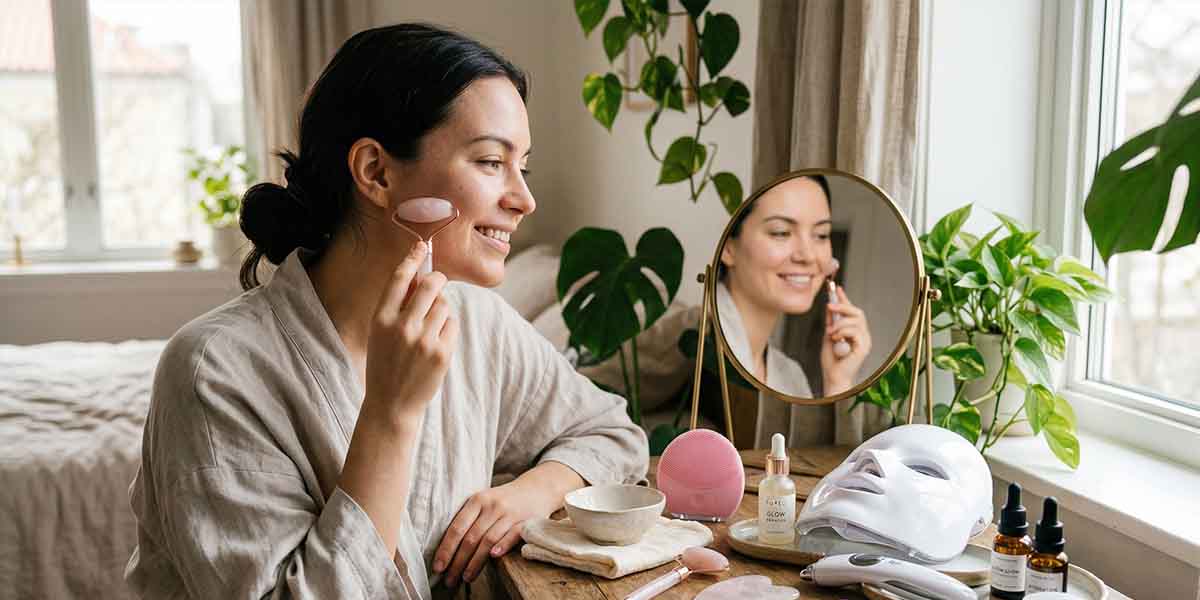
These two have had their moment in the social media spotlight, and while they are not magic, they are not useless either. Jade rollers and gua sha stones are rooted in traditional Chinese medicine and have been used for centuries. The modern version of these tools focuses mostly on lymphatic drainage, reducing puffiness, and improving circulation.
The jade roller is the gentler of the two — a simple rolling motion from the center of the face outward and downward helps move fluid toward the lymph nodes. It feels good, it is relaxing, and it takes about three minutes. The gua sha stone requires a bit more technique. Using it with a facial oil, you scrape the stone at a low angle across the skin to release tension in the facial muscles, encourage blood flow, and sculpt the jawline and cheekbones.
Neither tool will permanently change your face structure, but regular use can reduce morning puffiness and leave your skin looking refreshed. Pop them in the fridge for a few minutes before use for an added de-puffing effect.
3. LED Light Therapy Device
This is where skincare tools start crossing into legitimate clinical territory. LED light therapy has been studied extensively, and the results are encouraging. Different wavelengths of light target different skin concerns, and at-home devices now bring this technology out of the dermatologist’s office.
Red light (around 630–700 nm) stimulates collagen production and accelerates cell repair, making it popular for anti-aging and wound healing. Blue light (around 415 nm) kills the bacteria responsible for acne breakouts. Some devices combine both, along with near-infrared light for deeper tissue penetration.
Masks like the Dr. Dennis Gross DRx SpectraLite or the CurrentBody LED Mask have become favorites among skincare enthusiasts who want professional-level results at home. They are not cheap — quality devices start around $200 and can climb well above $500 — but for consistent use over months, many people find the results worth it.
Consistency is everything with LED therapy. A ten-minute session a few times a week over several months will show more results than sporadic marathon sessions.
4. Microneedling Roller (Dermaroller)
Microneedling might sound intimidating — tiny needles, rolling across your face — but at the right needle depth, it is both safe and remarkably effective. The concept is simple: creating micro-injuries in the skin triggers the body’s natural healing response, which floods the area with collagen and elastin. Over time, this leads to smoother texture, reduced scarring, and a more even complexion.
At-home dermarollers typically use needle lengths between 0.25mm and 0.5mm. These lengths are shallow enough to stimulate the skin without causing serious damage, and they also improve the absorption of serums applied immediately after — some studies suggest absorption can increase by several hundred percent post-needling.
Sanitation matters enormously with this tool. Replace your roller regularly, sterilize it before and after every use, and never share it. If you have active acne, rosacea, or any open wounds, skip the dermaroller entirely until the skin has healed.
Deeper needle lengths (1mm and above) can produce more dramatic results but carry higher risk and are better suited to professional settings where proper sterilization and aftercare are guaranteed.
5. Face Steamer
A face steamer is one of those tools that feels indulgent but pulls its weight in a practical routine. Warm steam opens up the pores, softens the skin, and makes it much easier to follow with extraction, cleansing, or a mask. Think of it as preparing the canvas before you paint.
Steamers are particularly useful before applying clay or charcoal masks, as the open pores allow the mask to draw out impurities more effectively. They also add a layer of hydration — something especially valuable in dry climates or during winter months when the air inside is constantly dried out by heating systems.
You do not need anything fancy here. A countertop nano steamer from a brand like Nano Ionic or NanoSteamer works well and costs under $50. Use it for eight to ten minutes, then follow immediately with the rest of your routine while your skin is still warm and receptive.
6. Microcurrent Device
If LED light therapy is the slow and steady of the skincare tool world, microcurrent is the one people turn to when they want to see results fast. These devices send tiny electrical currents through the skin to stimulate the facial muscles — essentially giving them a workout. The effect is often described as a natural facelift because the muscles tone and lift after consistent use.
The NuFACE Trinity is probably the most recognized name in this category, but other brands like ZIIP and Bear by FOREO have entered the market with their own takes. Most devices require a conductive gel to be applied to the skin before use — this helps the current travel evenly and protects the surface.
Microcurrent is not recommended for people with pacemakers, epilepsy, or who are pregnant. For everyone else, five minutes a day of consistent use is where most brands recommend starting. Results tend to be visible within two to four weeks, though like most skincare, they fade if you stop the routine.
7. Ultrasonic Skin Spatula
The skin spatula is one of the more underrated tools in skincare right now. It uses ultrasonic vibrations — roughly 28,000 times per second — to loosen and lift the debris that sits in pores and on the skin’s surface. Think of it as a gentle, non-abrasive exfoliation that does not rely on scrubbing.
To use it, you dampen your face, hold the spatula at a 45-degree angle, and glide it across the skin in short strokes. The flat edge vibrates and effectively scoops out blackheads, sebum, and dead skin without any irritation. It is surprisingly satisfying to see what comes off the skin in the process.
Many spatulas also have an infusion mode where the vibrations help push serums and moisturizers deeper into the skin, maximizing their effectiveness. For the price — most are between $30 and $80 — it offers a lot of versatility in a single device.
8. Eye Massager
The skin around the eyes is thinner and more delicate than anywhere else on the face, and it shows its age first. An eye massager targets this area with a combination of heat, vibration, and sometimes airbag compression to improve circulation, reduce puffiness, and ease the tension that builds up around the eyes from screen time and stress.
Some devices are simple wand-style tools with a vibrating metal tip that you roll around the orbital bone. Others are full masks that cover both eyes and offer a spa-like experience with built-in heating elements. Brands like Naipo, Renpho, and Breo have popular options in the $30 to $100 range.
Using an eye massager for ten minutes at the end of the day is a good way to decompress and simultaneously work on reducing dark circles and fine lines. Pair it with a dedicated eye cream and the benefits compound over time.
9. Blackhead Extractor and Vacuum Tool
Manual extraction has been a part of skincare since forever, and while aestheticians and dermatologists use professional tools, there are solid at-home options too. A basic comedone extractor kit — those small metal tools with a looped end — gives you more control and causes less damage than squeezing with your fingers.
Pore vacuum devices are a newer spin on this. They use suction to draw out blackheads and sebum plugs without any manual pressure. They come with interchangeable heads for different areas of the face and suction levels for different skin sensitivities. Devices like the PMD Clean or various models from Amazon have become popular for at-home use.
Do not overdo suction around the cheeks — too much can cause bruising or burst capillaries. Always steam or cleanse first to open pores, and never use these tools on inflamed or active breakouts.
10. Silicone Face Mask Brush
This one might seem simple compared to everything else on this list, but swapping your fingers or an old paintbrush for a silicone applicator is a genuinely good habit. Silicone bristles do not absorb product the way traditional brushes do, which means less waste. They are also much easier to clean, which means less bacteria being spread across your face every time you apply a mask.
A good silicone brush ensures even application of clay masks, sheet mask essences, and overnight sleep masks. It also keeps the mask off your hands so you are not washing off the product before it even gets to work. Small upgrade, noticeable difference.
How to Build Your Tool Routine Without Overdoing It
The temptation after reading a list like this is to order everything at once and launch into a nightly routine that takes an hour. Resist that impulse. Your skin needs time to adjust to new inputs, and layering too many new tools at once makes it impossible to know what is actually helping and what might be irritating things.
A smarter approach is to start with one or two tools and give yourself four to six weeks to observe results. Pick based on your primary concern — congested pores, dull skin, fine lines, puffiness — and choose the tool that directly addresses it.
A reasonable starter combination for most people:
- A silicone cleansing brush for deeper daily cleansing
- A jade roller or gua sha for morning depuffing
- An LED mask a few times a week for skin repair
From there, you can layer in the more intensive tools — microcurrent, microneedling, ultrasonic spatula — as your skin acclimates and your budget allows.
Final Thoughts
Good skincare has never been about having the most products or the most expensive gadgets. It has always been about consistency, knowing your skin, and making informed choices. The tools on this list are not shortcuts — they are upgrades that work best when layered on top of a solid foundation of cleansing, moisturizing, and sun protection.
Some of these tools will be a perfect match for your skin type and lifestyle. Others may not be worth it for you personally. That is completely fine. The goal is to build a routine that feels sustainable and that you actually look forward to — because the best skincare routine is the one you stick to.
Take it one tool at a time, pay attention to how your skin responds, and enjoy the process. Your skin is a long-term relationship — treat it accordingly.